
It Ends With Me
Fieldnotes on family systems, inherited trauma, reconciliation, and the quiet courage to stop carrying what was never yours to keep.

I was listening to a conversation the other day -
between Oprah Winfrey and a death doula.
They were speaking openly about family,
about grief, about reconciliation, about the complicated emotional terrain people often find themselves standing in near the end of life.
Not prescribing.
Not insisting.
Just exploring the human reality of it all.
And like certain conversations do,
it stayed with me.
It got me thinking about closure.
About healing.
About the assumption many of us quietly carry:
that peace must happen in relationship, that resolution always requires reunion, that another person must participate for something inside us to finally settle.
Sometimes that’s true.
And sometimes,
the work happens somewhere else entirely.
Sometimes the work is quiet.
Private.
Ritual.
Not about going back -
but about letting go.
⸻
There’s a practice I return to when things feel unfinished.
You write it down.
The memory.
The story.
The role you keep playing.
The version of yourself that only exists in relation to someone else.
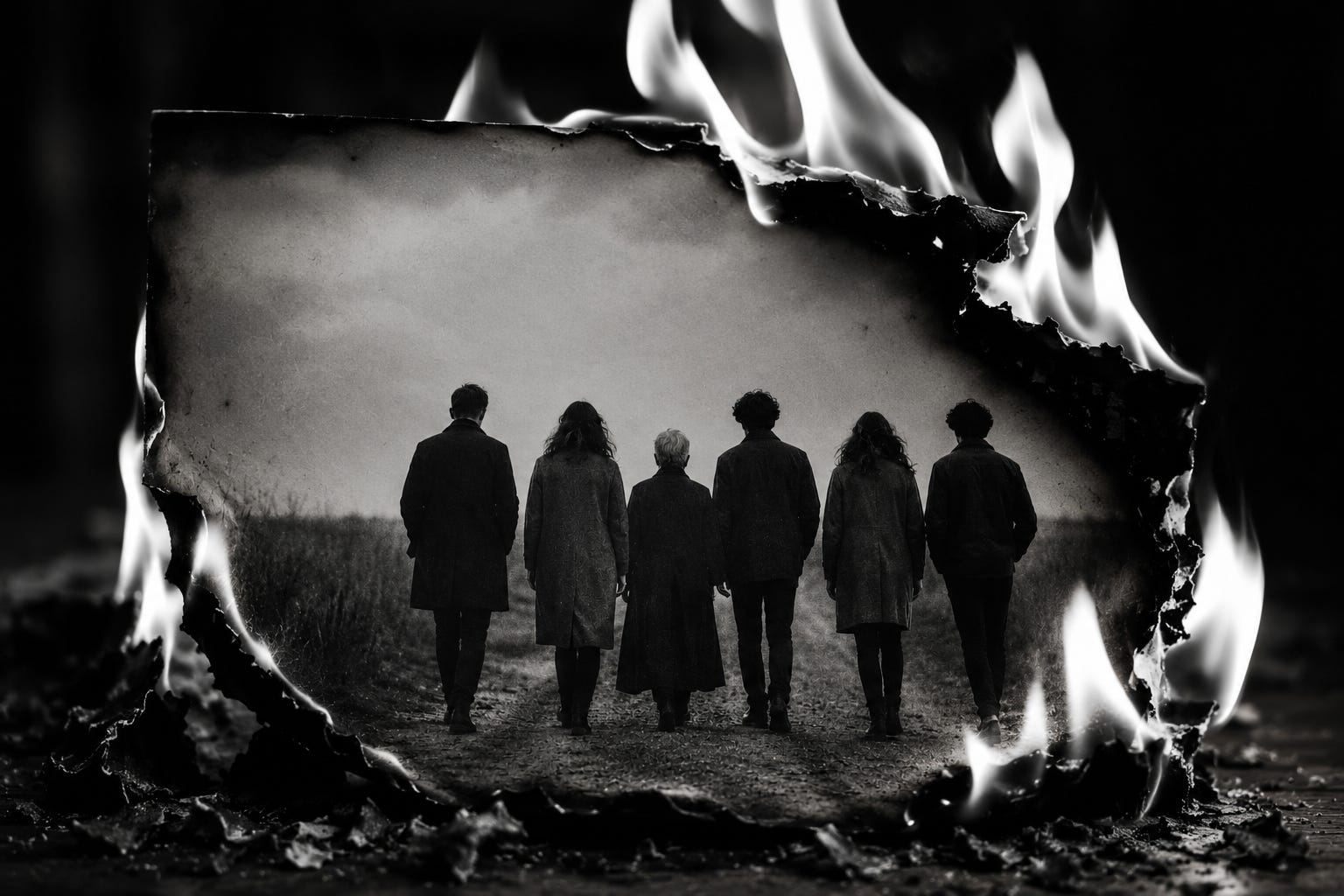
And you burn the paper.
Not to erase what happened.
But to release the energy of carrying it forward.
To say:
this ends here.
Not with them.
With you.
So when I hear people talk about “making peace before people pass,” I understand the longing behind it.
But I also wonder:
What if some peace isn’t made in conversation?
What if some endings don’t require permission?
What if the closure is not relational, but internal?
⸻
We don’t talk enough about how primitive the need for family really is.
Not sentimental, neurological.
Tribe equals safety.
Belonging equals survival.
Exile equals danger, if you ask the oldest parts of the brain.
So when you decline the wedding.
Or the reunion. Or the milestone where everyone will be there…
You may not be in the room,
but your nervous system absolutely is.
Because somewhere deep inside,
your amygdala is doing ancient math:
Who are you without your people?
What happens if you don’t return?
What if you regret this?
Enter the nattering aunt archetype,
who lives in most of us:
You’ll regret it.
Blood is thicker.
Family is family.
And that’s where this stops being theoretical.
Because trauma doesn’t politely stay in one generation.
It travels.
Through silence.
Through loyalty contracts.
Through what never gets named but shapes everything.
Just because you came through a family
doesn’t mean you’re meant to keep carrying its injuries forward.
And sometimes choosing yourself feels exactly like betrayal to a system that depends on your participation.
⸻
People ask:
Is it okay to keep the line drawn?
To never speak again?
To skip funerals?
To protect your peace even when it looks like absence?
I don’t have a universal answer.
But I do know there are things you can’t unsee.
Positions you can’t unhear.
Moments where trust doesn’t fracture, it rearranges permanently.
We weren’t able to attend my own grandparents’ funerals.
Not because of lack of love.
But because of safety.
Because of what surfaced around those losses.
Because grief doesn’t always make people kinder, sometimes it makes them more themselves.
And once you’ve seen certain dynamics clearly,
you don’t unlearn that.
So what do you do with that?
You carry the grief.
And the clarity.
At the same time.
⸻
Then there’s the quieter kind of family rupture.
Not explosive.
Just… accumulated.
Words said before wisdom arrived.
Stories frozen at their most defensive version.
Therapy language turned into permanent architecture.
“My therapist told me not to” has become the modern shield.
And look, I believe in therapy.
Deeply.
But therapists only ever hear one angle of a three-dimensional story. And even that angle depends on how conscious someone is of their own impact, their own blind spots, their own accountability.
So sometimes distance is protection.
And sometimes it’s just loyalty to an old identity that hasn’t been questioned yet.
Both can look identical from the outside.
⸻
If you zoom out far enough, family trauma is not just personal - it’s cultural.
Entire bloodlines still organized around grievance.
Entire nations shaped by inherited narratives of injury and retaliation.
We talk about nervous system trauma, but let’s be honest - some of this is blunt trauma.
And some of the wars we see in the world are just family dynamics scaled up to history.
So when we ask,
“Should I reconcile?”
what we’re really asking is:
Where does responsibility end?
And where does self-betrayal begin?
Who ends the pattern?
And who gets to say when it’s over?
⸻
Here’s what I know, at least for myself.
As I’ve slowed down.
As I’ve started living at a more human pace.
As I’ve learned the difference between peace and numbness…
I’ve forgiven a lot.
I love, with boundaries.
I tolerate things now that only hurt in memory, not in the body.
And sometimes that’s real healing.
And sometimes, the line still stays where it is.
Not out of punishment.
But out of integrity.
Because forgiveness doesn’t always require proximity.
And compassion doesn’t always require participation.
There’s no clean formula here.
But there is karma - not cosmic bookkeeping, but lived consequence.
Our actions shape our nights.
They shape what we carry into sleep.
They shape whether our nervous system settles, or stays on watch.
And that matters.
⸻
So when people talk about mending everything before people die, I understand the longing behind it.
But I also believe some endings are meant to be private. Some healings are meant to be internal. Some stories are meant to stop being rehearsed, even if they are never resolved.
Not burning bridges in rage.
But burning contracts in silence.
Letting certain roles, expectations, and unfinished conversations turn to ash, not because there was no love, but because there is finally enough self-respect to stop repeating.
Maybe the work isn’t who we reconcile with.
Maybe the work is what we finally release.
So that what comes after
has a chance to be lighter.
More honest.
More free.
And maybe that, too, is a kind of peace …
one that doesn’t wait for permission,
or timing, or anyone else’s understanding.
Just the quiet courage to say:
this ends with me.
« Our actions shape our nights.
They shape what we carry into sleep.
They shape whether our nervous system settles, or stays on watch.
And that matters. »
This deeply resonated.
I’ve been hiding the tension between the honest feeling of hurt and needing distance and the honest feeling of regret for being harsh.
Your writing has helped me see a 3rd option, a way through that is neither reconciliation with nor expansive resentment, but rather release.
Release of the storied my mind created to justify my hearts feelings and my mouth’s behaviour, and also release of the relationship that was shown in a truer light for what it was not.
Thank you 🙏
Thia one hits. Thank you.