
Watching Ourselves Live
Fieldnote on the difference between being there and proving you were

“Put your fucking phones down and I’d love you more.”
Madonna
She didn’t say it from a stage built for distance.
She said it from inside the room.
Not above it.
Not beyond it.
Inside it.
And still …
a forest of hands,
holding little glowing rectangles,
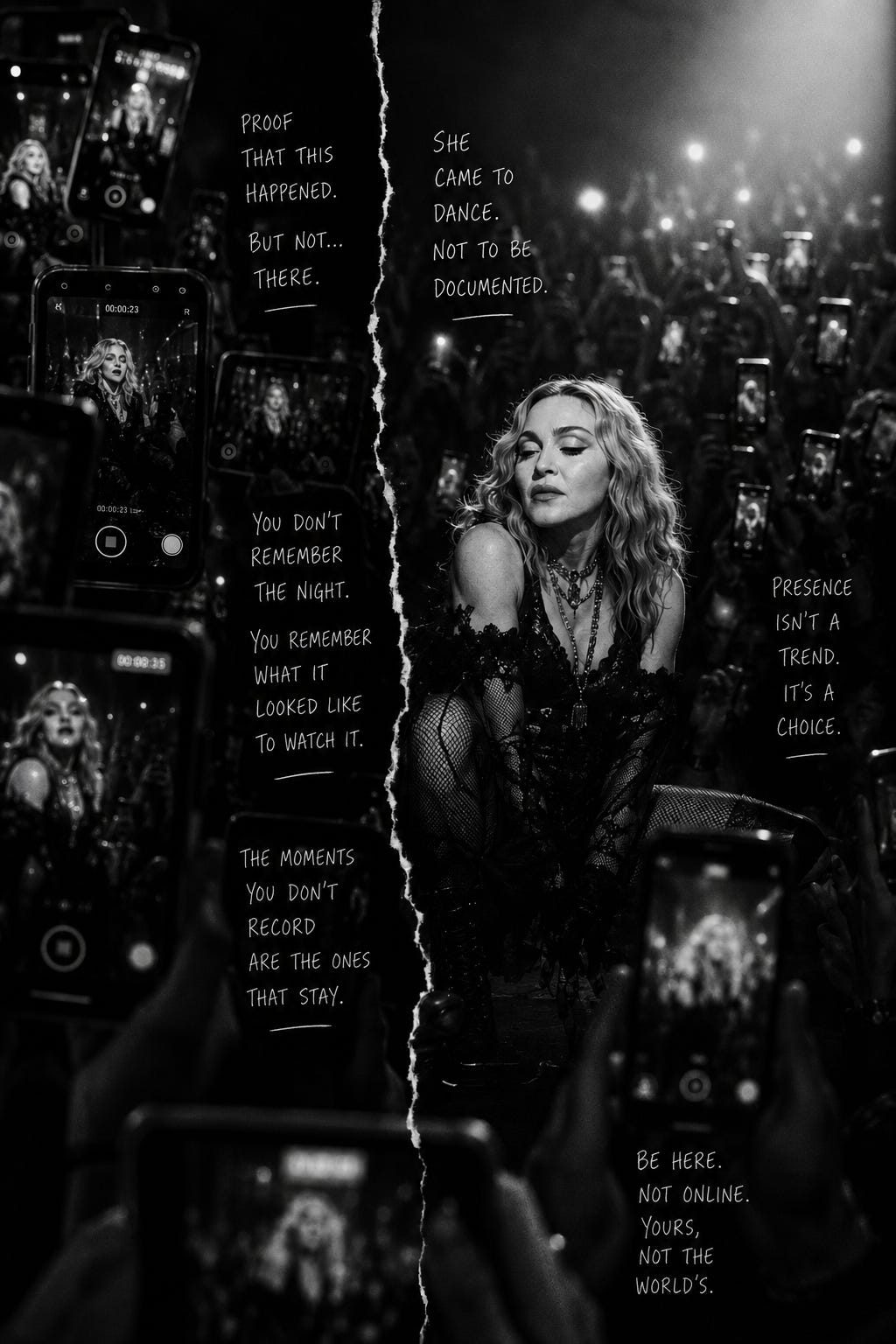
all pointed at her
like evidence.
Proof that this happened.
Proof that they were there.
But not… there.
—
Imagine that for a second.
You grow up in an era where she isn’t just an artist …
she’s disruption, permission, survival.
If you were queer in the 80s or 90s, she wasn’t optional.
She was oxygen.
And now she walks into a nightclub…
no spectacle, no distance, no algorithm -
just a body,
music,
presence.
She came to dance.
And the room… records her.
—
I saw it again at Coachella …
that surprise appearance with Sabrina Carpenter.
People paid to be there.
Wanted to be there.
And then chose
to experience it
through a screen.
That’s the part that stays with me.
—
And it’s not just concerts.
That’s just where it’s easiest to see.
It’s everywhere now.
Presence -
as a trend.
Breathwork.
Cold plunges.
Meditation.
Yoga at sunrise.
All of it pointing to the same thing:
Be here.
—
And still …
phones on tripods.
Cameras angled just right.
Moments framed for later.
Presence… documented.
Shared.
Consumed.
—
We’ve built an entire language
around being in the moment,
and then stepped just outside of it
to show everyone else we were there.
—
Scroll long enough and you’ll see it.
Someone slowing down.
Someone breathing deeply.
Someone “offline.”
And you pause for a second …
maybe three,
before your thumb keeps moving.
A brief encounter with presence.
Not participation.
—
And if I’m honest,
I’ve probably done my own version of this too.
—
And maybe this is where the tension actually lives.
Not in “kids these days.”
Not in blame.
In memory.
Because here’s the part that isn’t just poetic,
it’s neurological.
Memory doesn’t store what happens.
It stores what you attend to.
And attention has limits.
The hippocampus, the part of the brain responsible for forming memory, doesn’t archive everything in front of you.
It encodes what your awareness prioritizes.
So when you’re watching something through a screen …
framing it, adjusting it, checking it,
you’re not just recording the moment.
You’re reallocating your attention.
And your brain follows that.
There’s even a name for it,
the photo-taking impairment effect.
People who document experiences often remember less of them.
Not because the moment wasn’t meaningful,
but because the brain quietly decides:
I don’t need to hold this.
It’s saved somewhere else.
—
So what gets stored isn’t the night.
It’s the angle.
The screen.
The distance.
—
Which means,
when you go back to it later…
you’re not remembering the moment.
You’re remembering
what it looked like
to watch it.
—
Because some of us remember
a version of this world
before it needed to be witnessed to count.
We remember what it felt like
to disappear into a night
and never once think to prove it happened.
That’s not superiority.
It’s just… a different imprint.
A different relationship to being here.
—
So when I watch a room full of people
holding the moment at arm’s length,
it’s not judgment that rises.
It’s something closer to sadness.
Like watching something sacred
get translated into a language
that can’t quite hold it.
—
And underneath that,
a quieter question I can’t shake:
Are we actually searching for presence?
Or just performing it
for each other
in a loop that never quite lands?
—
Because presence, when it’s real,
doesn’t ask to be witnessed.
It doesn’t announce itself.
It doesn’t archive well.
It just… happens.
And then it’s gone.
—
So maybe it’s simple.
Not easy.
But simple.
The next time something real is happening …
a song,
a conversation,
a body moving in front of you,
just leave it.
Leave the phone where it is.
Let the moment go unrecorded.
Let it exist only in you.
Unshared.
Unproven.
Yours.
—
Because memory isn’t a recording device.
It’s a relationship with attention.
And attention…
is where you decide
whether you were there at all.
—
Because here’s the part no one tells you:
The moments you don’t record
are the ones that stay.
And the ones you do …
you end up watching them later,
like they belonged to someone else.
Really great read…Presence just is. As you said so well, it’s a relationship with attention.